Skip to content

General Discussion

General discussion for the Flow Battery Research Collective

This category can be followed from the open social web via the handle general-discussion@fbrc.nodebb.com

36 Topics 478 Posts
  • New member introduction thread!

    Pinned
    52
    0 Votes
    52 Posts
    5k Views
    kirkK
    Hi @Santiago-Eduardo, and welcome! We'd definitely be interested in collaborating, I will reach out to you via email. Thank you for the invitation!
  • Following your documentation – feedback & questions

    60
    1
    3 Votes
    60 Posts
    5k Views
    G
    @danielfp248 Thanks. So I’ll wait for the results you can achieve with the same setup I’m using. Regarding the suction-based pump configuration - I’ve been thinking about it too. Generating underpressure behind the cell would likely remove leakage issues. However, it is a more energy-consuming solution, so it doesn’t seem suitable as a final approach for a large battery system. Also, with the pumps operating in suction mode, any sealing imperfections would likely result in air being drawn into the system... Thanks again for running the photopaper membrane tests - looking forward to the numbers.
  • Life Cycle Assessment (LCA) for the FBRC redox-flow battery

    4
    0 Votes
    4 Posts
    268 Views
    S
    @kirk Hello Kirk, we wish you two a happy new year! Thank you for your answer. So we´re going to analyse Option 1: Electrolyte-membrane interactions. Therefore, we make a LCA, which includes transportation, production and use-phase. We have some more questions: Friendly reminder to answer the general questions mentioned in our previous blog post: General questions: • How much energy supply does a RFB require (for one cycle/in total)? • Which electricity mix is currently used to operate the battery (is there a proportion of green electricity)? • Where are the materials purchased? From which countries are they delivered and how (train, car, ship)? • In which country are the batteries assembled and tested? Do you have any data of the composition and volume of the electrolyte of the large-format cell design? Or should we scale up the chemicals from the 2 cm² RFB to the 175 cm² RFB? ◦ Electrolyte composition: 4M KI, 2M ZnCl2, 1M NH4Cl in deionized H2O → Is M equivalent to mmol/L or mol/L? ◦ Electrolyte volume: 5 mL (anolyte) + 5 mL (catholyte) Do you have an assumption for how many cycles the matte photo paper could last? How long do the tests of the RFB last (in minutes/hours)? We need this information to calculate the power consumption. We would gladly like to accept your offer of building columns for weight, manufacturing process, and material, into the BOM of the project. We look forward to hearing from you. Kind regards, Rieke Huesmann, Anita Thaqi, Stella Vucemilovic
  • MyStat control software refactor

    2
    1 Votes
    2 Posts
    224 Views
    kirkK
    This is great sepi! A calibration wizard would be excellent, thanks for taking this on. I cloned your repo and was able to launch it on my PC, happy to help test in the future!
  • My build (very slowly progressing)

    61
    2
    3 Votes
    61 Posts
    5k Views
    kirkK
    @sepi Without the four-wire control the pump speeds are definitely harder to manage, sorry to hear that, though the PWM regulator may help. Can you visually see how different the rotation speeds are? That should be rough proxy for volumetric flowrate. I am not surprised they won't spin below 11 V. @sepi said in My build (very slowly progressing): Is this 20-40ml/min measured with the cell in line or just the pump. Ideally best to measure with the cell inline, to be closer to the actual conditions. However, as the tubing wears, this can drift, just FYI. Not a huge deal but something to be aware of. @sepi said in My build (very slowly progressing): Is the figure obtained with water or electrolyte? Water for now, just as a proxy, minimize exposure to electrolyte. This is kind of a 1, maybe 2 significant digit measurement, no more (the volumetric flowrate). @sepi said in My build (very slowly progressing): What would you recommend doing against the excess flow? @sepi said in My build (very slowly progressing): the left passing up to 40% more water at the same voltage. At the same voltage, is the left pump spinning at (nearly) the same rate as the right? if they are spinning at the same rotational speed and the left is passing 40% more water, it sounds like there is some flow restriction in the right pump's flow loop. If they have identical flow loops (in terms of pressure drop), and are set at the same voltage, I would guess that they should rotate at similar speeds, but this may not be the case for the brushed motors (e.g. variance in motor properties). What is important for testing, is that both pumps are above a minimum flowrate to ensure good mass transfer, and that the pressure imbalance between the two sides isn't too great as to cause transfer of electrolyte from one side to another through the separator. If the flowrates aren't perfectly matched but those two previous conditions are met, it's not a big issue, although it's just better for repeatability for them to be the same.
  • Tygon chemical for sale

    9
    2 Votes
    9 Posts
    450 Views
    sepiS
    The tubing is gone now, thanks for buying at my store
  • Thin sleeves to insulate screws (no more tape)

    7
    1
    3 Votes
    7 Posts
    534 Views
    sepiS
    @doho that's a great idea, I'll give it a try!
  • Designing the large-format cell

    63
    5
    1 Votes
    63 Posts
    5k Views
    kirkK
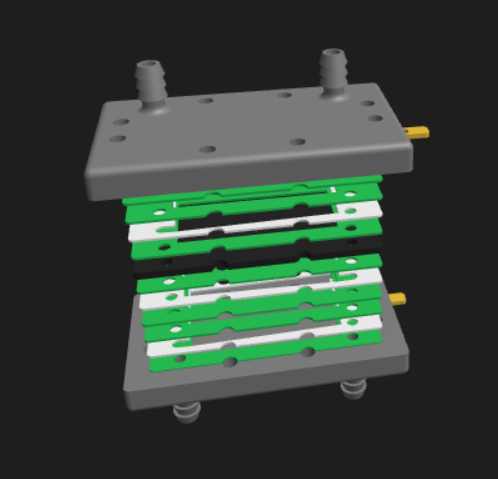
    Here is a video of assembling the large-format cell. https://spectra.video/w/m9RKg1QWrFdkkn9qUBFMTS FYI, you are meant two use two endplates per side (I used one here), I intentionally left the graphite felt out as this was for leak-testing, and the cell is missing washers on one side. The video illustrates the basic process of assembling our cell and how it is designed and seals. All the design files are available at https://codeberg.org/FBRC/RFB-large-format-cell. The setup is essentially there, waiting on chemicals and sorting out the power electronics set up and we should be able to run our first real charge/discharge tests with this large-format cell! The work to get to this point has been supported by the NGI0 Entrust Fund, a fund established by NLnet, to whom we are very grateful!
  • 0 Votes
    1 Posts
    79 Views
    No one has replied
  • This topic is deleted!

    1
    0 Votes
    1 Posts
    17 Views
    No one has replied
  • This topic is deleted!

    1
    0 Votes
    1 Posts
    22 Views
    No one has replied
  • 3D printed barbed connector

    ting 3dprint
    4
    1
    3 Votes
    4 Posts
    328 Views
    sepiS
    My pumps didn't have them, only the ones built into the pump. I saw that on some of your pictures, you have additional fittings between the different elements, I guess to make it easier to connect and disconnect the cell. In the end, it might make more sense to just shrink the barbs on the flowframe and/or tank a bit so the tubing comes off mor easily.
  • Separator material

    16
    1 Votes
    16 Posts
    913 Views
    sepiS
    @danielfp248 ah, that makes sense as a last resort measure but would it not be nice to not lose charge? Well it all depends on how easiy it is to counteract by setting a different flow for the different electrolytes.
  • This topic is deleted!

    3
    1 Votes
    3 Posts
    8 Views
  • Theoretical Practical tank size limit

    15
    0 Votes
    15 Posts
    809 Views
    D
    @Vorg We will slowly get there but no, right now we don't have any kWh capacity battery. As I mentioned, it will be several years before we get there. The fun is to walk this path and make everything open source on the way.
  • MyStat PCBs for free

    14
    1
    2 Votes
    14 Posts
    799 Views
    D
    @sepi Hi, if you do the selling of the tube, I would order 2 (two) meters.
  • RFB University

    7
    3 Votes
    7 Posts
    501 Views
    sepiS
    @danielfp248 sorry, my question was not well formulated. I meant a potential between the electrolytes inside the cell independently the possibility of measuring them using an electrode. Or to formulate it differently, if you cut through the cell (lile you cut a sandwich) and plotted the electrical potential between the electrodes, how would it look like?
  • Blog: czahl's build

    30
    5
    2 Votes
    30 Posts
    2k Views
    D
    @czahl I am a huge fan of trying this, especially for the larger format where setups are likely to be more permanent. As kirk mentioned we have never actually tried it, so please let us know if you do!
  • Towards a working system

    19
    1
    3 Votes
    19 Posts
    1k Views
    Q
    @muntasirms Absolutely! A bunch of other great documentation on here, wanted to try to my part. I have a colleague who uses HIPS exclusively in strong alkaline systems. Significantly easier to print than PP from my limited experience. It's not pure polystyrene (which is great for alkaline), but the additive(s) don't seem to affect their tolerance too much. I'll keep you posted on compatibility as I test these systems! Not sure how long the parts will last yet.
  • Systems engineering and modeling

    9
    0 Votes
    9 Posts
    582 Views
    M
    @kirk @sepi I think Bert's models are free to download off his site, but if you wanted to read the paper, I'm happy to email them to you or you can reach out to him for a copy.

0

Online

74

Users

50

Topics

569

Posts