Skip to content

General Discussion

52 Topics 560 Posts

General discussion for the Flow Battery Research Collective

This category can be followed from the open social web via the handle general-discussion@fbrc.nodebb.com

  • New member introduction thread!

    Pinned
    72
    0 Votes
    72 Posts
    19k Views
    kirkK
    welcome @martinr and @jpengineering ! Iron hybrid RFBs are very appealing but managing hydrogen evolution is the real challenge---we've been working on some promising approaches here, Daniel has done some tests on a non-conventional iron electrolyte here: https://fbrc.nodebb.com/topic/44/only-fe-system. I haven't seen Nighthawk's carbon felt video, but @rowow came through the forum already talking about his membranes! I'd like to get my hands on some to try (don't have the time right now to go into DIY membranes---we are using porous separators for the moment since they don't give us issues and we are mostly focused on cell/electrolyte R&D).
  • New version of development kit

    1
    0 Votes
    1 Posts
    125 Views
    No one has replied
  • New MYSTAT software v1.2.2

    1
    1 Votes
    1 Posts
    96 Views
    No one has replied
  • 0 Votes
    3 Posts
    465 Views
    kirkK
    from this paper, seems like nanomaterial synthesis needed: https://www.nature.com/articles/s41560-026-02091-w#Sec25 also they use triflate salts --- that's likely more expensive than the Zn (and, fluorine-containing, with all that entails)
  • 0 Votes
    14 Posts
    270 Views
    ?
    @bipolaron @kirk This project in Switzerland is currently building a 2.1 GWh capacity / 1.2 GW output redox-flow battery. Scheduled to go online in 2029, and by their own PR material "the largest in the world". https://www.swissinfo.ch/eng/climate-solutions/switzerland-builds-worlds-most-powerful-redox-flow-battery/91181119
  • Made a video on FBRC

    2
    3 Votes
    2 Posts
    383 Views
    B
    I caught the version on YT, but having the same vid on PT is great.
  • This topic is deleted!

    0
    0 Votes
    0 Posts
    2 Views
    No one has replied
  • Video on Edison battery

    2
    0 Votes
    2 Posts
    497 Views
    V
    The battery looks interesting but has some problems. From what I've read, it tends to use up the water in the electrolyte fairly quick by splitting into hydrogen and oxygen. Also, It's working voltage is ~1.2v but it needs 1.6v (1.65v if added lithium) to take a change? The inverter I'm leaning towards now, GTIL2000, for low cost and simple connection has an input range of 45v-90v. When using a 48v LFoP battery, it only can produce about 1300w. With a 72v, it's around 1700w according post on a solar forum. One of these batteries with enough sells to put the charge voltage just below 90v with give me a battery that only has about 60v when no solar to charge it. That would really cripple the inverter. Here is a few videos of someone messing with this battery making his own electrodes and a gell electrolyte in an effort to improve the battery. https://www.youtube.com/watch?v=NaOzDt83XWY https://www.youtube.com/watch?v=0mYaei0O1sU https://www.youtube.com/watch?v=pjoxC4kwA9I
  • MYSTAT software v1.2.1

    1
    0 Votes
    1 Posts
    150 Views
    No one has replied
  • No pump flow battery, likely not useful, but interesting

    4
    0 Votes
    4 Posts
    626 Views
    V
    https://www.youtube.com/watch?v=t09aBKUejSs&list=PLYDTEjzfnaSVHeUiCOX5Z9G7i_AiSifpR&index=10
  • New video of cell testing process

    1
    1 Votes
    1 Posts
    180 Views
    No one has replied
  • Build-a-Batt - A fully parameterized flow cell stack model

    3
    3
    2 Votes
    3 Posts
    583 Views
    kirkK
    Also, this reminds me of the OpenAFPM project - they also use FreeCAD and provide a dashboard for people to input custom parameters for a small wind turbine generator, there is some FEM, and then design files are output. There is a video demo here: https://www.openafpm.net/cad-visualization I know a few of the folks behind that project, I'm sure they'd be happy to give input on how to accomplish a similar goal but for flow batteries.
  • Calcium-ion Battery

    2
    0 Votes
    2 Posts
    1k Views
    kirkK
    This video seems to be AI generated and doesn't have that much real information? I have seen Ca-ion systems from (I think) a German group that looked good, but had a lot of organic synthetic steps if I remember correctly.
  • You Tuber Video on an open source all Iron battery

    3
    2 Votes
    3 Posts
    491 Views
    D
    The cost per kWh of this is too high, the use of organic materials and ion exchange membranes puts this closer to what people do in academia and further from the cells that can be reasonably fabricated using DIY approaches. The use of an ion exchange membrane likely reduces the lifetime of this cell a lot. For a static cell, I think the sulfuric acid Cu/Mn battery we have discussed before is far more promising. That chemistry requires no exchange membranes, uses only commodity inorganic materials and cycles to 30-40Wh/L. For pure Fe batteries I am much more inclined to the Fe flow batteries.
  • Using cnc router cut PVC foam boards as cell frame

    2
    0 Votes
    2 Posts
    433 Views
    kirkK
    @rowow said in Using cnc router cut PVC foam boards as cell frame: The long term goal and my personal next goal is to get into injection molding which of course is the best option. At scale, definitely! @rowow said in Using cnc router cut PVC foam boards as cell frame: Ill see about uploading the cell fusion 360 model A .step file would also be great so I could look at it in FreeCAD! I don't have a Fusion 360 license. I'd be curious to see if we could take a similar approach.
  • Upcoming improvements to the dev kit

    7
    4
    1 Votes
    7 Posts
    1k Views
    kirkK
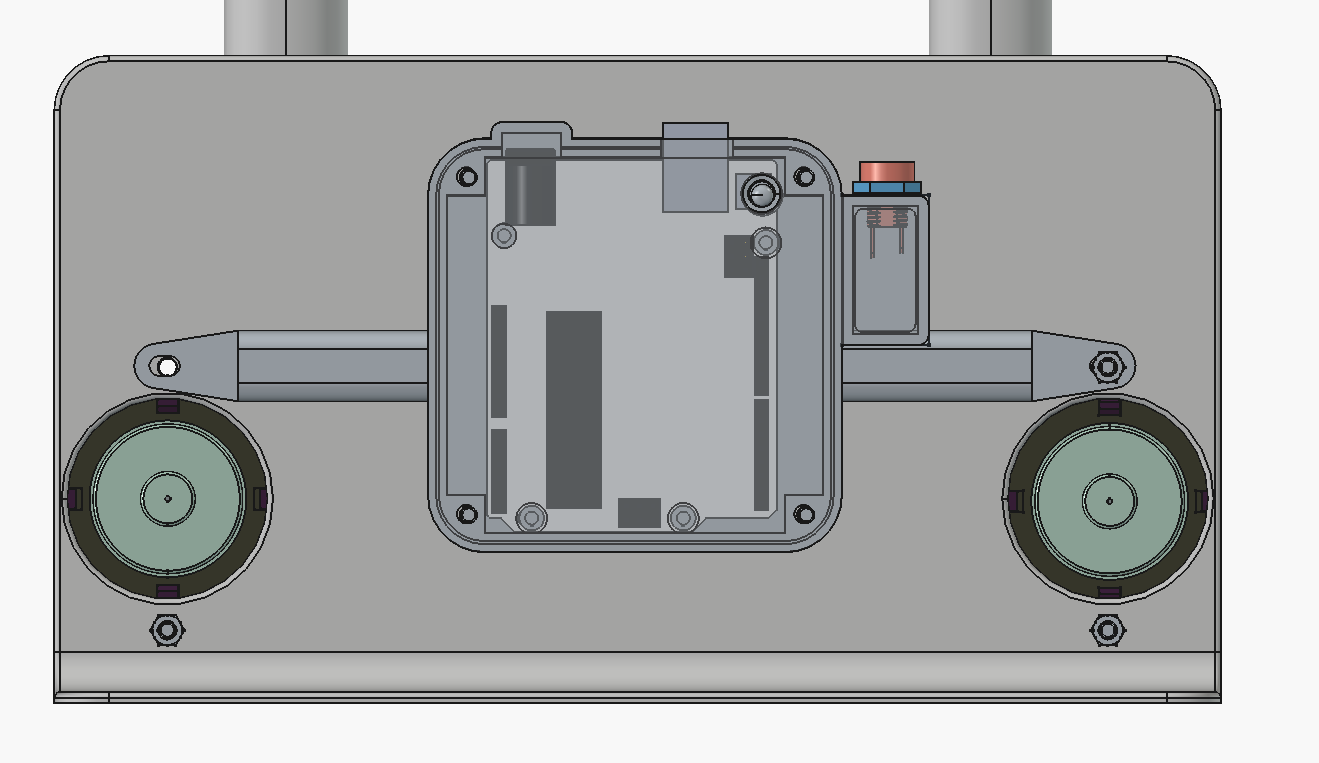
    @doho said in Upcoming improvements to the dev kit: I have try-ed to download Your new files from github (.stl and .pdf), but the files all appeared as broken, even in github. The files to sprint for the new endplates are here: https://codeberg.org/FBRC/RFB-dev-kit/src/branch/clampable-cell/CAD/exports [image: 1771858819246-1c46bc80-7e99-4780-8178-46d24a289a32-image.png] I haven't updated the new You have to download them individually, unless you clone the repository with Git LFS set up---the large CAD files are handled with LFS and without LFS installed downloading the repository just downlaods a pointer/reference to the CAD file, not the actual file (at least that's how I understand it). Let me know if this works for you!
  • My Suction Luer Lock

    4
    2 Votes
    4 Posts
    599 Views
    kirkK
    Very nice work @doho ! It's great to see your setup. @doho said in My Suction Luer Lock: But for getting reproducible resultants the flow through the cell should be down to up, but not horizontal (how much would be air isolating in the chamber when changing parts?) This is a good point, from what I've seen in other applications cells should generally clear air/produced gases by flowing against gravity from bottom to top, that is still possible with the new setup but the tubing from the pump outlet to cell inlet would have to be slightly longer. In my jig redesign I'll take this into account when writing the documentation.
  • This topic is deleted!

    10
    0 Votes
    10 Posts
    3k Views
  • 0 Votes
    1 Posts
    275 Views
    No one has replied
  • Designing the large-format cell

    66
    5
    1 Votes
    66 Posts
    18k Views
    kirkK
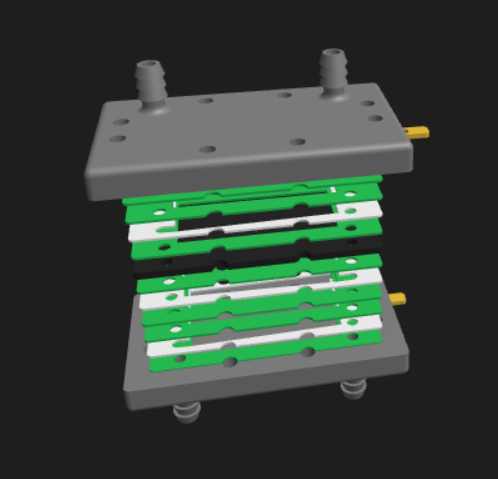
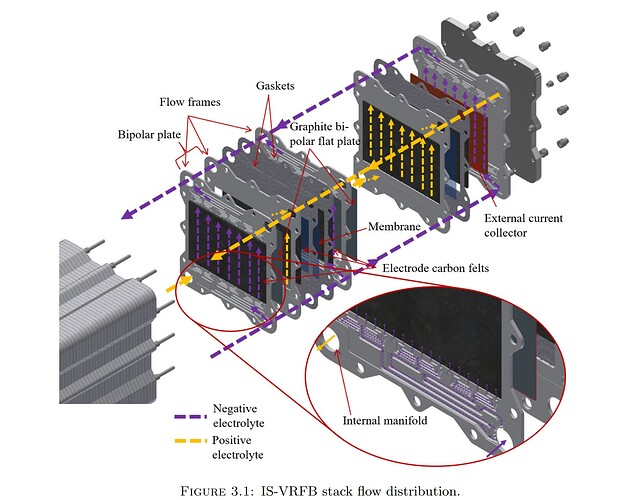
    Did another leak test today with water, correctly with 2x ~12 mm plywood endplates each side. Saw no leaks through the edges which was great news, but the barbed connections on the cell showed signs. Also, the MP-6R pumps struggle with the current flow frame design, which has 0.8 mm wall thickness and a 1 mm internal channel (electrode area therefore 2x0.8 + 1 = 2.6 mm thick). I remade (and pushed to the repo) the flow frame with a 3 mm internal thickness, in order to alleviate this pressure drop. Here is the test setup, I ran out of tubing (ordered 2m but they sent 1 m ), so the connections aren't ideal but this time no kinks in the flow path. Note, I put these drain valves in, of course they are pointing the wrong way for now, will need to elevate the setup so they can point down in the future. [image: 1769764493660-9fafda86-7f70-439f-9ecb-eeb9a7316215-img_20260129_153901-resized.jpg] Because all the connections are on one side (in anticipation of stacking these cells), I also made "front" and "rear" versions of endplates, inner/outer current collectors, and gaskets in the FreeCAD files. This will make low-volume prototyping a bit more expensive but more robust against leaks, which no one wants! [image: 1769763690358-037a7741-97dc-4012-8e95-cf8ab8760653-image.png] This is the dimension that went from 1 mm to 3 mm to facilitate using MP-6R pumps. [image: 1769763764115-d4ac6efb-4694-4d13-a941-8ffb85995001-image.png] We have the MP-6R now. It is the 6W high-flow version. the MP-10 is also 6W but lower flow / 50 % higher max pressure, then the MP-15R can do almost 3x higher pressure than the MP-6R but at 10 W. @danielfp248 can hopefully print the 3mm flow frames and I can get them at FOSDEM, then try them out. If it turns out we need the bigger pumps, I'll order them from AliExpress: [image: 1769763852108-f14b9379-cbc5-4542-940c-b33c0bacdb14-image.png]

0

Online

93

Users

64

Topics

659

Posts