Hi all, and apologies for the delay! This year has started off with quite a lot of administrative burden for me and I haven't had as much time for research as I anticipated.
@Santiago-Eduardo said in Life Cycle Assessment (LCA) for the FBRC redox-flow battery:
Elektrolyte:
The group noticed that two slightly different electrolyte compositions are mentioned.
Sorry for the confusion, the correct mass composition can be found in the documentation here: https://fbrc.codeberg.page/rfb-dev-kit/electrolyte.html, the masses listed will prepare approximately 10 mL of electrolyte.
@Santiago-Eduardo said in Life Cycle Assessment (LCA) for the FBRC redox-flow battery:
They assume an 880 ml volume for one single cell. Do you estimate this volume to maintain the obtained results until now? Is this the volume foreseen to achieve the 22 Wh/single large-format cell?
Yes this would be correct volume scaling for the large-format cell, although of course still a lot smaller than an eventual life-size system! It is basically t]e volume that we will end up using for our tests of the large-format cell (still to come).
@Santiago-Eduardo said in Life Cycle Assessment (LCA) for the FBRC redox-flow battery:
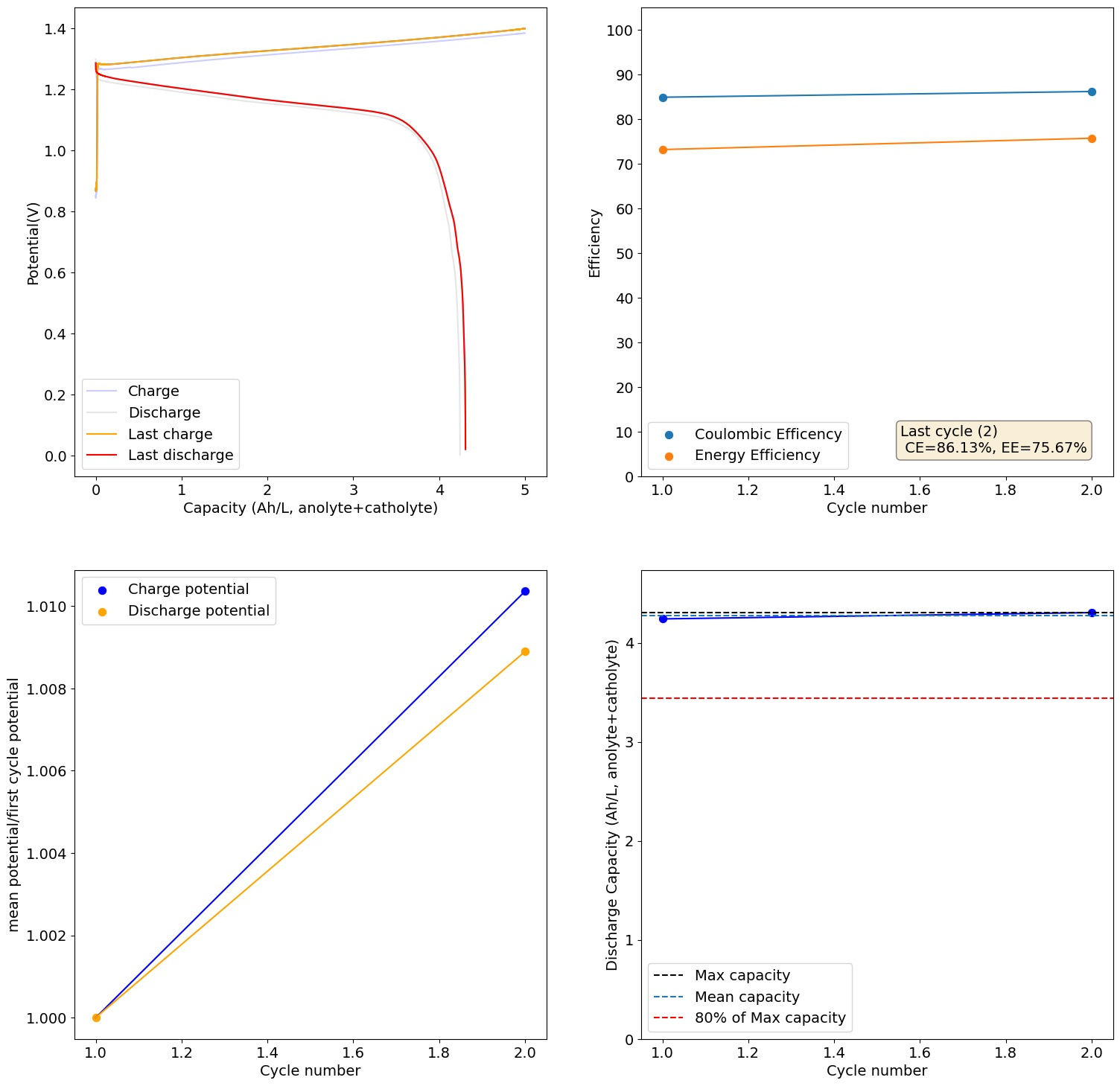
The group is assuming the EE value to estimate this. This value does not include energy demand from pumps and electronics, correct?
Correct, these losses are often summed up in RFB literature as "balance-of-plant" or BoP if you want to search for some values.
@Santiago-Eduardo said in Life Cycle Assessment (LCA) for the FBRC redox-flow battery:
Meaning: to store 1 Wh, 1.56 Wh needs to be taken from the grid (excluding electronics and pumps). Does this make sense, or are we oversimplifying here?
You've got it exactly!
@Santiago-Eduardo said in Life Cycle Assessment (LCA) for the FBRC redox-flow battery:
Used electricity
For the same purpose of modelling the use phase, it is important to define from which country and what type of energy/electricity is being used to charge the electrolyte. Since the users of the FBRC battery can be anywhere, but are currently mostly centered in Europe, the group has decided to choose the European electricity grid mix data to represent the current FBRC reality.
This makes sense to me.
@Santiago-Eduardo said in Life Cycle Assessment (LCA) for the FBRC redox-flow battery:
The separator, for instance, would be one of these peripheral impacts, since it would need to be replaced after some cycles (probably faster than the electrolyte). Since cycle durability of photo paper is still unknown, the group will model different scenarios from 10–100 cycles in steps of 30 cycles. Do you feel this is a reasonable range? Do you already now conditions such as density and flow rate the larger cell will work with? The group will assume 4 layers for the larger cell although in some parts are 3 layers stated.
While separators can be replaced, I am doubtful in an industrial system that they would, due to the labor costs. From my understanding, Li-ion lifetimes are often given as 2,000 cycles to 80% of initial capacity; for flow batteries, the data isn't as solid, but for VRFB the lifetime claims are more on the scale of 20,000 cycles or 20 years, whichever comes sooner (taken with a grain of salt...). We haven't done any testing that long-term, so don't have much for your to extrapolate, but RFB technoeconomic papers with operation and maintenance (O&M) costs incorporated would give you a good idea of membrane/pump replacement
frequency (if ever). I would increase the cycle range to much longer terms, with the upper end in the 1,000s at least.
We aren't yet locked-in on flow rates for the large cell as we are still settling on choice of pumps and flow field design.
@Santiago-Eduardo said in Life Cycle Assessment (LCA) for the FBRC redox-flow battery:
The current BOM and building instructions do not provide specific links to purchase the necessary chemicals. To model the electrolyte production, including the transportation of each chemical, the group has assumed the following production locations based on market data and worldwide production trends. If your own experience differs in this, please do not hesitate to comment.
These assumptions all make sense to me; Daramic separator (which we also use in addition to paper depending on the test) can/is produced in the EU though not exclusively.
I hope this clears things up for you all somewhat, and again, sorry for the delay!