
Following your documentation – feedback & questions
-
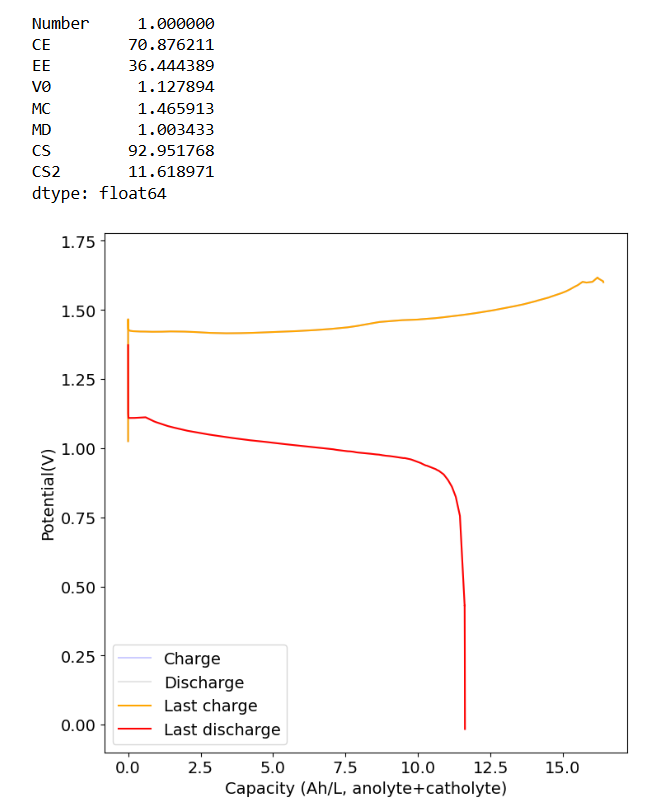
This is performance to 1.6V using the "suction" configuration and 3 layers of photopaper with carbon felt on both sides.
-
@danielfp248 Wow, that’s much more than I’ve ever been able to obtain. Did you do anything to the graphite felt or the paper membrane before using them? Did you use the default membrane frame from your documentation, or did you adjust the thickness to better fit three sheets of photo paper? What charge/discharge currents, capacities (mAh), and cycles (half-cycles) did you perform before achieving the result you posted? And what current did you use for the final charging of the cell - 40 mA or less? Are you planning to continue using pumps that generate a vacuum behind the cell, despite all the weak points of this solution?
-
@danielfp248 Wow, that’s much more than I’ve ever been able to obtain. Did you do anything to the graphite felt or the paper membrane before using them? Did you use the default membrane frame from your documentation, or did you adjust the thickness to better fit three sheets of photo paper? What charge/discharge currents, capacities (mAh), and cycles (half-cycles) did you perform before achieving the result you posted? And what current did you use for the final charging of the cell - 40 mA or less? Are you planning to continue using pumps that generate a vacuum behind the cell, despite all the weak points of this solution?
@gus No, this was both unmodified felt and membranes. This also didn't use any membrane frame, just the photopaper compressed between the silicon gaskets. The charge discharge current was set to 40mA. Before charge/discharge I circulated electrolyte for 15 minutes. I also did 2 cycles to 10mAh at 20mA to make sure I wasn't getting any abnormal behavior.
Also, we're planning to use the suction setup from now on, the safety improvements are worth the potential tradeoffs in my opinion.
-
@danielfp248 Thanks. So I’ll wait for the results you can achieve with the same setup I’m using.
Regarding the suction-based pump configuration - I’ve been thinking about it too. Generating underpressure behind the cell would likely remove leakage issues. However, it is a more energy-consuming solution, so it doesn’t seem suitable as a final approach for a large battery system. Also, with the pumps operating in suction mode, any sealing imperfections would likely result in air being drawn into the system...
Thanks again for running the photopaper membrane tests - looking forward to the numbers.
@gus said in Following your documentation – feedback & questions:
However, it is a more energy-consuming solution, so it doesn’t seem suitable as a final approach for a large battery system.
This "pulling through the cell" configuration is only possible with peristaltic pumps on the small scale, centrifugal pumps wouldn't handle this, due to net positive suction head/cavitation issues---this approach wouldn't end up in a real, real-world system, but we're going to recommend it for now at the benchtop scale to make testing easier!
-
@danielfp248 I always performed more cycles before starting 40 mA / 100 mAh charging (10 half-cycles at 20 mA / 10 mAh + 4–10 half-cycles at 30 mA / 10 mAh). The cell was also wet with demineralized water (leakage test). Could this also be the cause? I was also always using the membrane frame. Wouldn't the electrolyte leak through the paper membrane?
@kirk Apart from solving the electrolyte leakage issue, does this "pulling-through configuration" improve the total capacity of the system in any other way? Also, I am wondering whether you are using the default flow frame from the documentation (2 mm thick, right?) or a different one with another thickness and the 0.1 mm silicone gaskets.

Hello! It looks like you're interested in this conversation, but you don't have an account yet.
Getting fed up of having to scroll through the same posts each visit? When you register for an account, you'll always come back to exactly where you were before, and choose to be notified of new replies (either via email, or push notification). You'll also be able to save bookmarks and upvote posts to show your appreciation to other community members.
With your input, this post could be even better 💗
Register Login