Skip to content

World

Topics from outside of this forum. Views and opinions represented here may not reflect those of this forum and its members.

A world of content at your fingertips…

Think of this as your global discovery feed. It brings together interesting discussions from across the web and other communities, all in one place.

While you can browse what's trending now, the best way to use this feed is to make it your own. By creating an account, you can follow specific creators and topics to filter out the noise and see only what matters to you.

Ready to dive in? Create an account to start following others, get notified when people reply to you, and save your favorite finds.

Register Login
  • kirkK

    Hi all, we ask new members to please introduce yourselves here so we can get to know you and your interests!

    It would be nice for us to also know:

    • How did you find FBRC and this forum?
    • What is your interest in flow batteries?
    • How do you see yourself getting involved?

    Welcome, and thanks for being here!


    Welcome @oliver.schlueter and @nadia_avva ! We are definitely indeed all about the ownership of energy and energy technologies here you are in the right place! We'd love to connect our batteries to a small wind turbine (Piggott-style, probably) as soon as they are large enough... your and Oliver/OSE's wind experience could be very helpful!
  • kirk@social.coopK

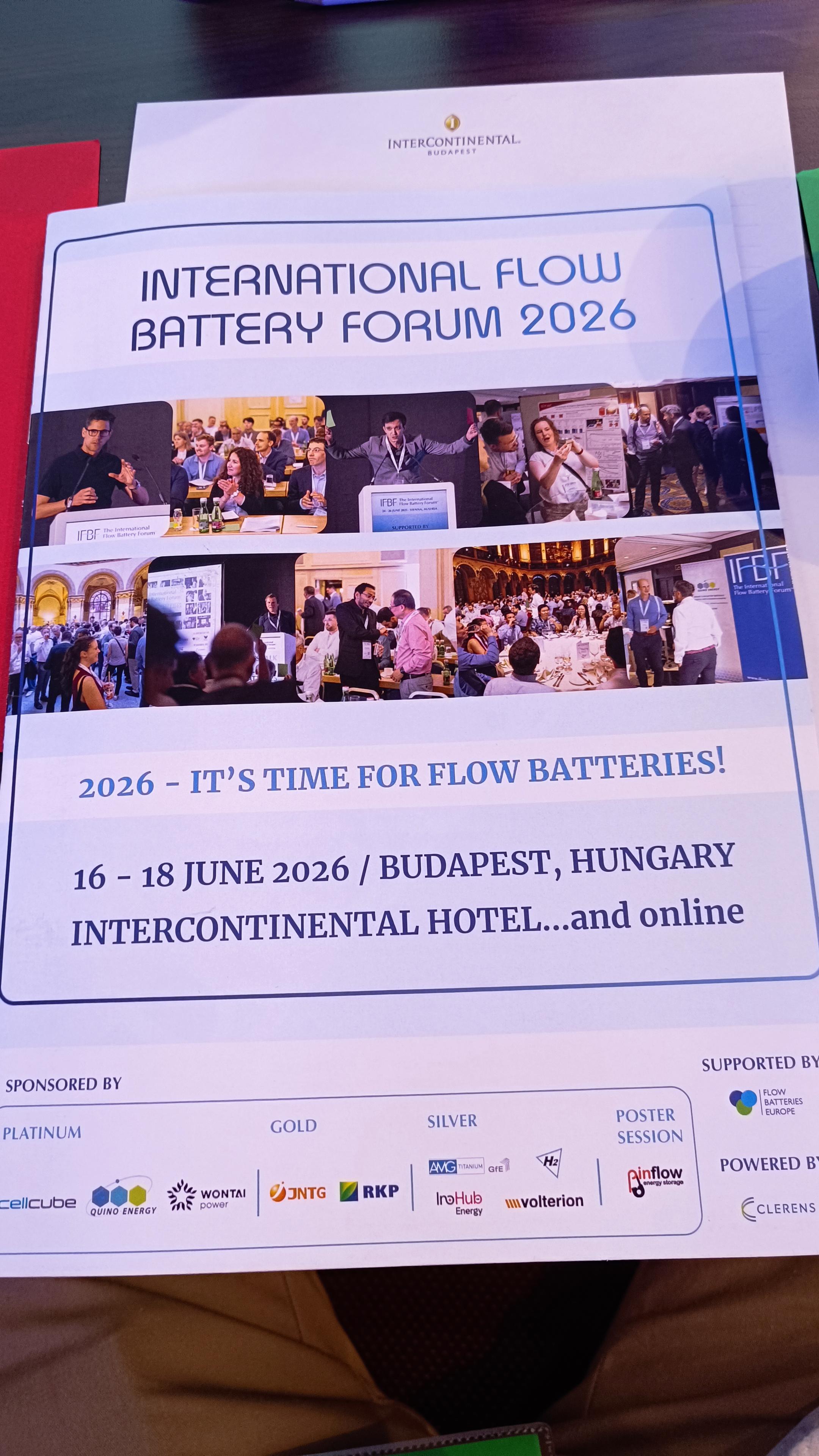
    Anyone have any questions for the flow battery industry players? At the world's biggest flow battery event at the moment! Vanadium, iron, organic systems, system integrators, electrode/membrane/pump manufacturers...


    read more →
    @bipolaron @kirk This project in Switzerland is currently building a 2.1 GWh capacity / 1.2 GW output redox-flow battery. Scheduled to go online in 2029, and by their own PR material "the largest in the world". https://www.swissinfo.ch/eng/climate-solutions/switzerland-builds-worlds-most-powerful-redox-flow-battery/91181119
  • kirkK

    Made a longer-form video explaining our open-source battery project and diving into the details of the kit and chemistries we're working with!

    It would really help our project out a lot if you could share this with interested folks.

    YouTube link (feed the algorithm): https://www.youtube.com/watch?v=xhWBX1eLDr8

    And of course, PeerTube: https://spectra.video/w/4wTobcS16Ww5UAZVMWrC9E

    Please let me know what you think, comments, criticisms, suggestions---first time I've made a video like this and I have a lot to learn.


    I caught the version on YT, but having the same vid on PT is great.
  • kirk@social.coopK

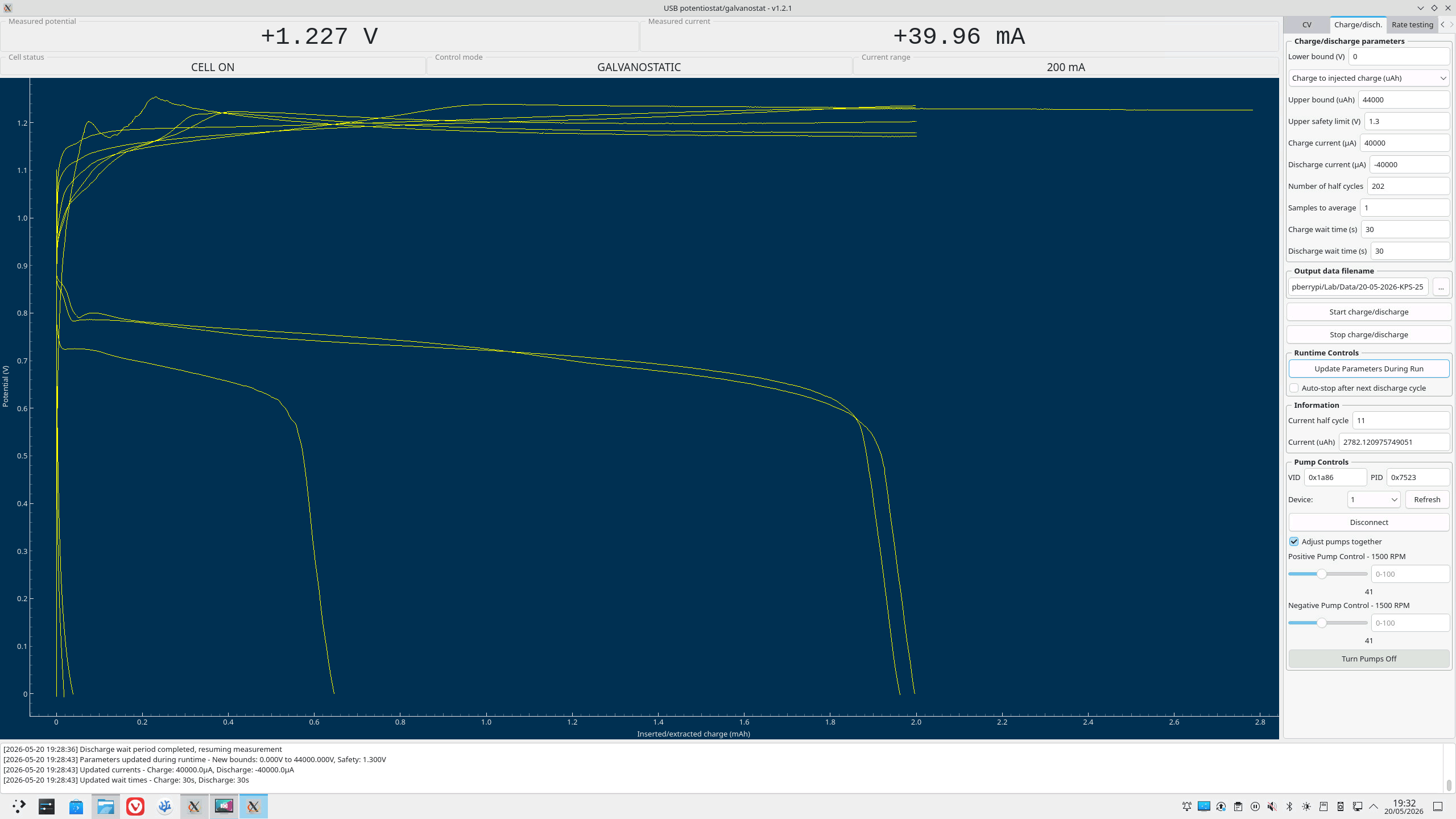
    cycling an all-iron flow battery!!

    First few "cycles" are oxidizing sacrificial excess ascorbic acid added to reduce initial Fe (III) present and minimize ambient oxygen. Charged 2 mAh and discharged until discharge capacity approached 2 mAh as ascorbic acid was oxidized. Now going to higher capacities 🤞


    I'm no chemist, so this may not apply here, but I've been looking at info on different batteries. I looked at Nickel/Iron because of their known long life. One change mention from original Edison design is adding a little Lithium oxide or dioxide ( forget exactly) to the electrolyte To extend the life of the Iron electrode. There was also something about making plates (instead of just using sheets of iron) using iron powder with carbon (for conductivity) and something else which I forget that reduced the production of hydrogen.
  • kirk@social.coopK

    Lab Notebook Entry #17

    Another Zn-I test, started off cycling too aggressively and formed iodine it seems

    https://dualpower.supply/posts/lab-notebook-17/


    Edit: after original post, realized that one connection lead was loose, and the negative pump tubing was blocked/degraded---PTFE liner had detached from the wall and formed some sort of blob inside the tubing, it seems.
  • V

    A lot of blabbering in this video on the Nickel/Iron Edison battery with lofty claims. So what is he not saying? How big does it need to be to provide useful power?

    https://www.youtube.com/watch?v=cWBZNq8Q3Hs


    The battery looks interesting but has some problems. From what I've read, it tends to use up the water in the electrolyte fairly quick by splitting into hydrogen and oxygen. Also, It's working voltage is ~1.2v but it needs 1.6v (1.65v if added lithium) to take a change? The inverter I'm leaning towards now, GTIL2000, for low cost and simple connection has an input range of 45v-90v. When using a 48v LFoP battery, it only can produce about 1300w. With a 72v, it's around 1700w according post on a solar forum. One of these batteries with enough sells to put the charge voltage just below 90v with give me a battery that only has about 60v when no solar to charge it. That would really cripple the inverter. Here is a few videos of someone messing with this battery making his own electrodes and a gell electrolyte in an effort to improve the battery. https://www.youtube.com/watch?v=NaOzDt83XWY https://www.youtube.com/watch?v=0mYaei0O1sU https://www.youtube.com/watch?v=pjoxC4kwA9I
  • kirkK

    Made some Linux AppImages of improved MYSTAT software for anyone who uses it! Also runs on Windows ofc, it's just Python.

    https://codeberg.org/FBRC/mystat/releases


  • kirk@social.coopK

    Lab Notebook Entry #16

    "Finished" the argon Zn-I test, but because it leaked. Made improvements to the dev kit design.

    https://dualpower.supply/posts/lab-notebook-16/


  • kirk@social.coopK

    Lab Notebook Entry #15

    10 cycles/2 days into the argon Zn-I test. It looks weird but... also good? I probably just jinxed it.

    https://dualpower.supply/posts/lab-notebook-15/


  • kirk@social.coopK

    Lab Notebook Entry #14

    Designed new reservoirs with Luer Lock fittings, started a Zn-I test under argon (Schlenk technique with welding gas), making progress on battery cycling setup for large-format cell

    https://dualpower.supply/posts/lab-notebook-14/


  • kirk@social.coopK

    Lab Notebook Entry #13

    Made it to 46 cycles/200 hours, the famed Zn-I "voltaic bulge" appears, blaming it on ambient oxygen. Time to bust out the inert gas 💸

    https://dualpower.supply/posts/lab-notebook-13/


    @idlestate also, some studies of these systems I think point to complexes being formed in solution, that contain both chloride and iodide/iodine, like ICl-, for example. They might show up with some spectroscopic techniques like Raman? So chloride can play more of a role than just supporting electrolyte.
  • kirk@social.coopK

    Lab Notebook Entry #12

    30 cycles, 133 hours, and now a UPS! Which has already saved my butt. And easier-to-read plots.

    https://dualpower.supply/posts/lab-notebook-12/


    @Methylzero "I heard you like batteries, so I got you a battery for your battery..." Definitely it's backing up a headless Raspberry Pi, a potentiostat, Arduino, and two peristaltic pumps.
  • kirk@social.coopK

    Lab Notebook Entry #11

    Cell cycled most of weekend, power cut interrupted cycling. 25 cycles, 110 hours, seems stable.

    https://dualpower.supply/posts/lab-notebook-11/


    I mean stable as in, it hasn't obviously degraded. "Stable" cycling means different things to different people ofc.
  • kirk@social.coopK

    Managing electrolyte volume imbalance in flow battery testing / Lab Notebook Entry #10

    16 cycles and 72 hours, signs of periodic self-balancing of electrolyte volumes

    https://dualpower.supply/posts/lab-notebook-10/


  • kirkK

    Filmed myself building a cell so you can see the whole process start-to-finish! Still working on updating the documentation for the clampable-cell branch. It works pretty darn well without any bolts.

    PeerTube: https://spectra.video/w/dxjsd8AR2uAvnA6UMnnb8G

    YouTube: https://www.youtube.com/watch?v=hT_5Bde2IVY


  • kirkK

    Starting a thread to keep track of our zinc-iodide development. Background in this blog post: https://fbrc.dev/posts/progress-update-dev-kit/#preliminary-results-from-first-chemistry-zinc-iodide

    Current electrolyte composition is roughly 2M KI, 1M ZnCl2, 2M NH4Cl, 5% triethylene glycol, with a Daramic separator and graphite felt on both sides, no spacer.


    It's the same electrolyte formulation as currently in the docs
  • M

    Hi folks,

    Over a couple weekends, I've been working on parameterizing the FBRC model. It was borne of a couple kinks I ran into - I would want to adjust bolt or hose barb diameters based on what I had lying around, or scale the model down for smaller lab scale setups while maintaining control over electrode thickness for lab experiments. The idea is to adjust a single parameter in a script, which then adjusts the appropriate dimension in all the design files, then spits them out for fabrication.

    The result is a single "model" with flexibility to adapt plumbing, sizing, and construction according to your particular application. So for example, the same parameterized model can spit out

    a small cell with hose barbs for lab scale applications (18cm2 electrode area)
    bf6726ff-e1a0-4007-9b1b-f272c408fe00-image.png

    a medium size cell (using the current FBRC large format sizing)

    b764f2f9-904a-471d-9e8b-ed6e3574af8e-image.png

    or a "fat stack" (3500cm^2) with extra, thicker bolts

    2502ef32-7e89-4d18-a38b-36d514a55119-image.png

    all from the same parameterized design. Once the designs are generated, all the associated STL, STEP, and DXF files can be downloaded for fabrication.

    If this is of any interest to you, I'm hosting the parameterized model in a webapp here and I've uploaded a short video walking through the general process here.

    I briefly discuss it in the video, but because the models are parameterized, it's easier to programmatically keep track of the locations of ports, walls, manifolds, etc. That makes boundary condition declaration and the like much easier to automate as well - so I'm in the process of slotting this into an automated hydraulics/electrochemical simulation suite. Imagine generating your custom model and simulating a "digital twin" for estimates of performance prior to purchasing materials or finalizing design.

    I'm very open to constructive criticism on any part of the project (from ideation to UX to engineering). Have fun fiddling with it and let me know what you think!


    Also, this reminds me of the OpenAFPM project - they also use FreeCAD and provide a dashboard for people to input custom parameters for a small wind turbine generator, there is some FEM, and then design files are output. There is a video demo here: https://www.openafpm.net/cad-visualization I know a few of the folks behind that project, I'm sure they'd be happy to give input on how to accomplish a similar goal but for flow batteries.
  • kirk@social.coopK

    Lab Notebook Entry #9

    Finally a decent test cell underway (it's not done yet!)

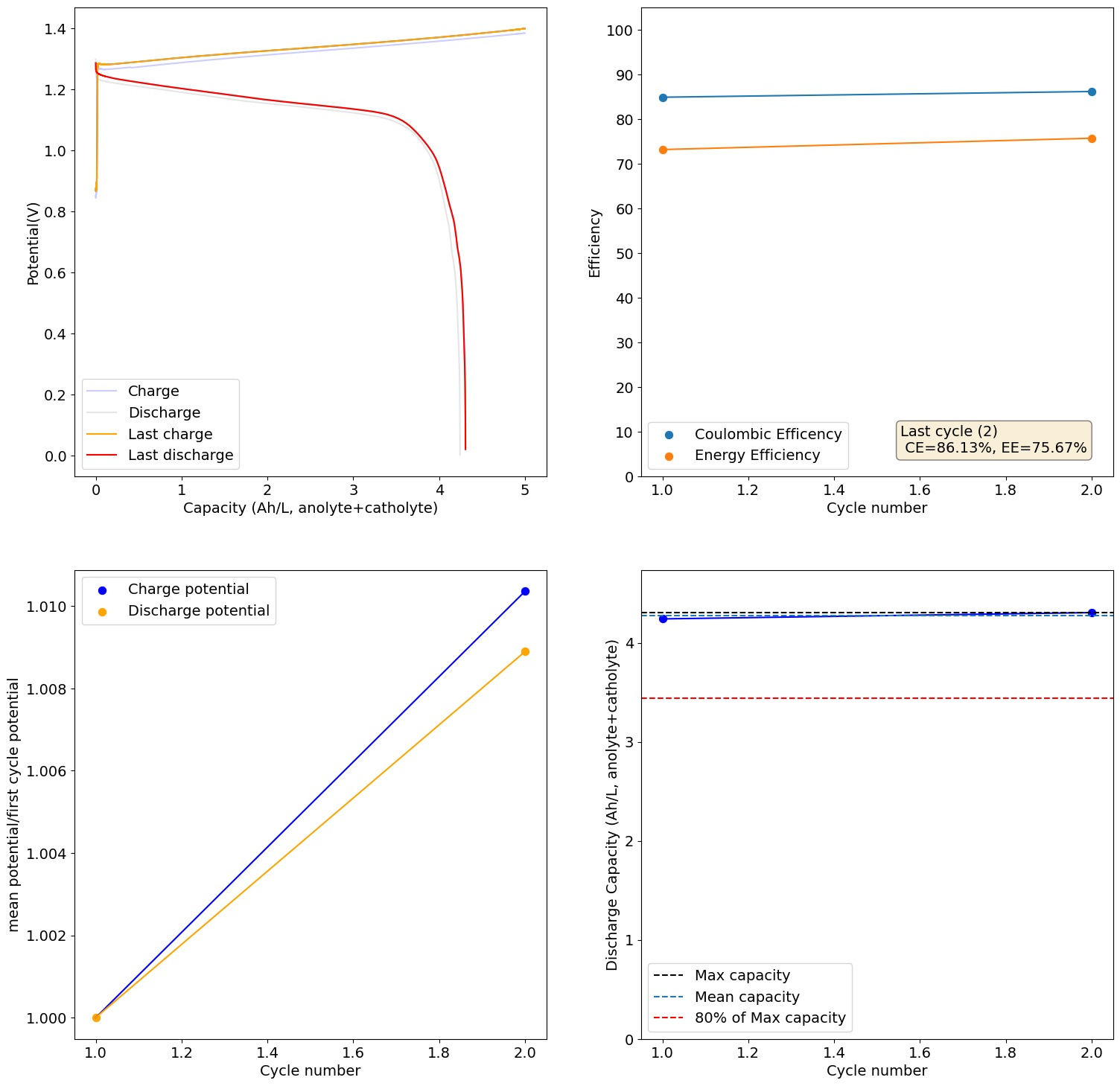
    Error bars getting smaller, energy efficiency over 70% for our standard zinc-iodide system.

    https://dualpower.supply/posts/lab-notebook-9/


    @trevorflowers thanks for the kind words, and please feel free to ask questions about things you don't understand! I'm writing these lab notebook entries in a concise way and not doing much explaining
  • danielfp@chemisting.comD

    On a previous post I discussed my first attempts at reproducing the Na-sulfamate based Zn-Br battery published by a group of Chinese researchers. My results showed that the chemistry works mostly as they showed, but I was unable to reproduce both the capacity and stability properties of their testing results. This post summarizes some additional research results I obtained with this chemistry and why, I believe, my results have been unable to match theirs.

    From the get go, my results showed significant declines in capacity when charging to the Nernst limit. This happened even at lower capacities and even at lower concentrations. Oftentimes with deterioration of the charging potential but sometimes with no changes in charging potential at all. This was irrespective of whether the buffer was prepared with just KAc additions, with HAc+KAc or with different buffer strengths. Additional HAc additions did not recover this capacity, which makes me believe that the losses are due to some permanent loss of the sulfamate inventory. Since these losses often happened with very little or no deterioration of the average charging potential, it also makes me believe these are not due to problems with Zn dissolution. After I opened the batteries I also saw no accumulation of metallic Zn on the anode felt or separator (while when it’s a problem with Zn reversibility you see some clear dead Zn remains).

    Charging to the Nernst limit (to 2.1V) shows some clear capacity losses as a function of cycling. The above is for a 0.5M ZnBr2, 0.5M KBr, 0.5M Na-Sulfamate solution in a 5 pH buffer prepared with KAc and 8% Acetic acid. 100% SOC would be close to 6.7Ah/L, as the reaction is limited by sulfamate on the catholyte side. Catholyte and anolyte electrolytes are identical on start. 25mA/cm2 current.

    If you read the original Nature paper carefully, you’ll also see that none of their charge curves ever reach the Nernst limit but they are carefully capacity limited to some predetermined value. This initially makes no sense – why would you choose to not use all your capacity? – unless there was a problem with either Zn dendrites or with some other side reaction. Given that Zn dendrites don’t seem to short the battery until much higher capacities, it seems clear that the problem must be elsewhere.

    To test this hypothesis I tested the reversibility at 50% of the SOC. It is clear that the deterioration slows down at this point. It is also clear that my cathode – being normal felt – is way less electrochemically active than the carbon nanotube and N-doped felt that is actually used by the Chinese research group. This makes me believe that sulfamate starts degrading at high SOC values, perhaps because N-Br sulfamate starts becoming so concentrated that double bromination becomes possible and then the double brominated N sulfamate is much more likely to decompose with degradation of the sulfamate, possibly into sulfate, ammonium and other brominated side products, like bromate or hypobromous acid. Perhaps the fancy cathode of the Chinese research group has much faster kinetics and is able to handle much faster Br transfers into sulfamate without exposing already brominated sulfamate to double brominations. However, since they don’t charge to the Nernst limit, it makes me believe that they still saw this when they tried charging to higher potentials, hence they didn’t.

    Perhaps the most important fact is that capacity recovers if you add more sulfamate, which pretty much confirms that the problem is due to sulfamate degradation.

    Same battery as described on the previous image but only charged to 3Ah/L capacity at same current density.

    The above implies that sulfamate, while able to support Zn-Br chemistry, is not as stable as it seems on the paper. Careful control over the charged capacity is needed and cathodes that allow very good kinetics for the bromination of the sulfamate are also required. Without significant engineering of the cathode material, it seems that you are limited to around 50% of the SOC – based on the sulfamate – if you want to avoid degradation of the sulfamate as a function of time.

    Also, capacities reported by the Chinese group seem to be based only on their catholyte volumes, therefore you have to divide all their values in half if you want to make real comparisons to Ah/L values. They still reach very high capacity values, very close to the actual 100% SOC levels for these systems, although without ever taking the batteries to the Nernst limit. My battery has much higher internal resistance than theirs, which also explains a lot of this difference (as my kinetics are slower, my potential increases much earlier).

    Long story short, you cannot just add sulfamate to a Zn-Br electrolyte and expect the battery to work like magic. As it is always the case in batteries, the devil is in the details.


4

Online

79

Users

62

Topics

640

Posts